
Bone marrow concentrate, usually called BMAC (bone marrow aspirate concentrate), is a preparation made from your own bone marrow. A physician draws marrow from a large bone, most often the pelvis, spins it in a centrifuge to concentrate the cell and growth factor fraction, and injects that concentrate into a painful joint or tissue. It is an autologous treatment, meaning the material comes from you. The evidence is encouraging for some knee patients, but it is mixed overall, and the honest answer to “does it work?” depends on the condition, the comparison and the timeline.
Many patients come to us after trying anti-inflammatories, physical therapy and cortisone injections, and they want to understand where BMAC fits before deciding anything. This guide covers what it is, how it is prepared, how it differs from PRP, what the research shows, what the risks and costs look like, and how to decide whether to discuss it with a physician.
TL;DR
- BMAC is a concentrate made from your own bone marrow, drawn from the pelvis or another large bone, processed in a centrifuge and injected into the problem area.
- Stem cells are only a tiny share of what is in marrow. The concentrate also carries growth factors and other nucleated cells, and how it works is not fully understood.
- In knee osteoarthritis, studies show BMAC outperforming hyaluronic acid, with no consistent difference from PRP. Results in the spine are less encouraging.
- Reported side effects are mostly mild and temporary, such as soreness or swelling. Coverage is often limited, so ask about costs up front.
- Whether BMAC is right depends on your diagnosis, imaging, age and goals, which is a conversation for an in-person evaluation.
Table of Contents
- What bone marrow concentrate is
- How the procedure works, step by step
- How BMAC is thought to work
- BMAC vs. PRP: the practical differences
- What the evidence shows by condition
- Safety, side effects and regulation
- Cost and coverage
- Who may be a candidate
- Our perspective
- Talk to a physician about your options
- FAQ
- Sources
What bone marrow concentrate is
Bone marrow is the soft, spongy tissue inside larger bones. It produces blood cells and also holds a mix of other cell types, including a small population of mesenchymal stem cells (MSCs), which can develop into bone, cartilage and other connective tissue. Bone marrow aspirate is the liquid drawn from that space. Bone marrow concentrate is what remains after the aspirate is processed to concentrate the useful fraction.
The stem cell part is smaller than most patient brochures suggest. A systematic review in PMC notes that only about 0.001% of the nucleated cells in bone marrow aspirate are mesenchymal stem cells, which is why concentrating protocols exist. A technical note on harvesting and processing puts progenitor cells at roughly 0.001% to 0.01% of the marrow population and adds that BMAC contains a high concentration of growth factors, including platelet-derived growth factor, transforming growth factor-beta and bone morphogenetic proteins 2 and 7.
So “stem cell therapy” is a convenient label, but BMAC is better understood as a cell and growth factor mixture. That distinction matters when you read claims online, because the benefit may come from several components working together rather than from stem cells alone.
How the procedure works, step by step
The process is outpatient and typically done in one visit. The details vary by clinic and device, but the sequence is consistent.
- Evaluation and imaging. Before anything is scheduled, your physician reviews your history, examines you and looks at imaging to confirm what is actually causing the pain.
- Numbing and harvest. The skin and the surface of the bone are numbed with local anesthetic. A needle then draws marrow from a site such as the back of the pelvis (the iliac crest). One published technique describes filling a 30-mL syringe preflushed with anticoagulant to collect the aspirate.
- Processing. The aspirate goes into a closed centrifuge system, typically in the same room. The same technical note reports that processing usually yields about 2 to 5 mL of concentrate. Laboratory methods exist as well, but automated closed systems are the common clinical approach.
- Injection. The concentrate is placed into the target joint or tissue, often with ultrasound or fluoroscopic guidance so it reaches the right spot.
Where the marrow is taken from matters somewhat. The same technical note reports that iliac crest and proximal tibia marrow have similar chondrogenic and osteogenic capacity, but the iliac crest may yield more mononuclear cells, and cell counts are lower in older patients. For that reason, surgeons often choose the pelvis when they want to maximize the cell count.
If you are wondering what the days afterward look like, we have written a day-by-day guide to care after bone marrow aspiration. In general, the harvest site is the part that feels sore, similar to a deep bruise, rather than the injected joint.
How BMAC is thought to work
Here is a point we make with patients early: the mechanism is not fully settled. The systematic review above explains that the MSCs in BMAC may serve as a direct cell source for repairing tissue, or the nucleated cells may act mainly through a paracrine effect, releasing cytokines and growth factors that direct the body’s own repair. It could be both.
The American Society of Pain and Neuroscience (ASPN) guideline summary describes a similar picture for injectable biologics in general. According to coverage of the ASPN guidelines, they appear to work mainly by creating an anti-inflammatory environment at the injection site, triggering the release of cytokines, growth factors and extracellular vesicles that help modulate inflammation and support tissue regeneration.
This is a more modest claim than “the cells rebuild the joint.” In practice, we think of BMAC as a way to change the biology of a painful, inflamed environment, which may reduce symptoms and improve function. It does not restore a worn joint to its original condition.
BMAC vs. PRP: the practical differences
Platelet-rich plasma (PRP) is the other biologic patients usually compare it to. Both are autologous, and both aim to support the body’s repair processes, but they start from different places.
| BMAC | PRP | |
|---|---|---|
| Source | Bone marrow, usually from the pelvis | Blood drawn from a vein in your arm |
| What it concentrates | Nucleated cells, a small stem cell fraction and growth factors | Platelets and their growth factors |
| Collection | Needle into bone under local anesthetic | Standard blood draw |
| Discomfort | Soreness at the harvest site for a few days | Minimal beyond the injection |
| Typical coverage | Often out of pocket | Often out of pocket |
A 2021 review comparing the two describes BMAC as coming from marrow and PRP as a blood product, each setting off repair through its own mechanism. It also notes that BMAC appears to work without PRP, but adding PRP to BMAC can act as a rich natural culture medium for stem cells.
Now the evidence question, which is the one patients care about most. In a study of 175 patients with knee osteoarthritis, 111 received BMAC, 30 hyaluronic acid (HA) and 34 PRP. At 12 months, BMAC scores were better than HA scores, with no significant difference between BMAC and PRP on WOMAC and partial IKDC scores, and no serious side effects. A 2024 review of injection therapy in knee osteoarthritis reported the same pattern across larger meta-analyses: BMAC beat HA, while PRP and BMAC did not differ significantly.
One recent analysis went further. A 2026 meta-analysis found no pooled benefit for bone marrow products at 6 months in arthrosis (5 studies), while PRP showed a moderate significant effect (24 studies). Those numbers come from a small set of BMAC trials with different methods, so we read them as a reminder that the research is still maturing, not as a verdict. The practical takeaway is that BMAC has not clearly beaten PRP, so the more invasive harvest has to be justified by your particular situation.
For knees specifically, our PRP knee pain overview covers costs and what to expect from the PRP side of the comparison.
What the evidence shows by condition
Knee osteoarthritis
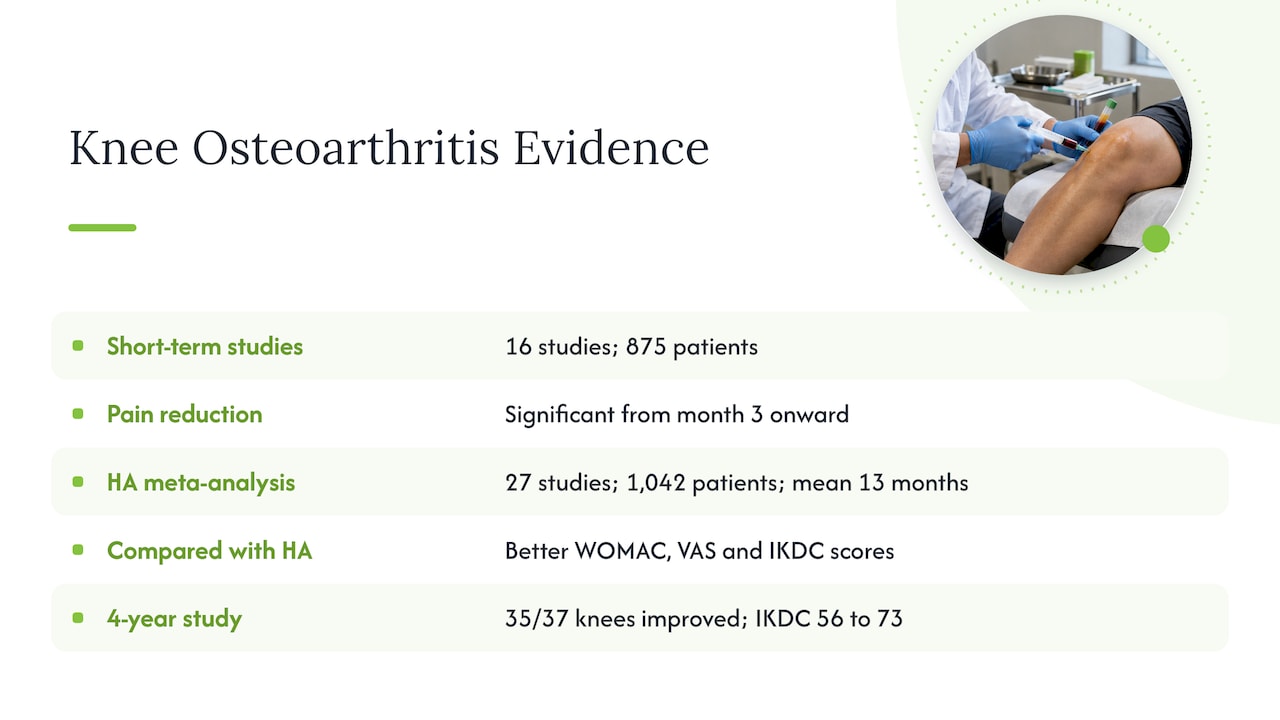
This is where BMAC has the most data. The 2024 review cited above reports a meta-analysis of 16 short-term studies with 875 patients receiving BMAC showing significant pain reduction on the visual analog scale from the third month onward. Another meta-analysis of 27 studies and 1,042 patients, with a mean 13-month follow-up, found better WOMAC, VAS and IKDC scores with BMAC than with HA.
Long-term data are thin. The same review states that, to the authors’ knowledge, only one study has followed BMAC patients with osteoarthritis for 4 years. In it, 35 of 37 knees improved, and IKDC scores rose from 56 to 73 on average. That is promising, but it is a single study without a comparison group in this summary, so it does not tell us how the average patient will do.
Some patients ask whether BMAC can delay a knee replacement. A 2026 meta-analysis in Pain, Joints, Spine found that PRP, BMAC and similar biologics performed better than HA and corticosteroids for pain persistence and for postponing arthroplasty, with good safety profiles. We would describe that as a reason for cautious optimism, not a promise that any individual will avoid surgery.
If you are also looking at non-injection options for arthritis symptoms, such as red light therapy for arthritis, these are typically discussed as part of a broader plan, not instead of a diagnosis.
Tendons, hips, shoulders and other joints
The picture is less consistent outside the knee. The ASPN guideline summary says some studies suggest potential benefit from BMAC and adipose-derived MSC injection for lateral epicondylitis (tennis elbow), while results in Achilles tendinopathy are inconsistent. For the hip, we generally begin the discussion with PRP, since the evidence base is larger. You can read our review of PRP for hip osteoarthritis for that reasoning.
The spine
Spinal conditions deserve a more conservative framing. The 2026 meta-analysis cited above notes that randomized trials in spondylosis did not show BMAC or MSC outperforming sham for primary pain and function endpoints, and it describes the pooled result for bone marrow products as a genuinely negative one. We take that seriously. In the spine, the first step is establishing exactly which structure is generating pain, because the right treatment, whether a targeted injection, a nerve procedure or rehabilitation, follows from that.
Safety, side effects and regulation
The published safety record is reassuring. A 2026 systematic review of randomized trials reports no serious adverse events directly attributed to BMAC or bone marrow aspirate among the trials that reported safety. The events that did occur were mostly mild and short-lived: post-procedural pain, swelling, joint effusion or discomfort at the donor site. In the 2026 meta-analysis of six randomized trials with 860 patients, complication rates were similar between BMAC and comparators, at 41.91% versus 41.25%.
Practical points for safe use:
- Tell your physician about blood thinners, bleeding disorders, infections or any recent illness before a bone marrow draw, since these can change whether and how the procedure is done.
- Expect soreness at the harvest site. Persistent or worsening pain, fever, redness or drainage after any injection or aspiration is a reason to call the clinic promptly.
- Follow the activity guidance you are given for the first days, since the harvest site and treated joint both need time.
On regulation, the American Association of Hip and Knee Surgeons states that PRP and BMAC are exempt from FDA regulation under 21 CFR 1271, and that indications, preparation and administration of biologics for hip and knee osteoarthritis vary across providers. Because the protocols are not standardized, two clinics offering “BMAC” may be doing somewhat different things. Ask who performs the harvest, what system is used and how the injection is guided.
Cost and coverage
This part should not be a surprise on the day of your visit. The authors of the harvest technique note state that in many health systems, harvesting and applying BMAC is not covered by routine health insurance, often leaving patients with out-of-pocket costs, and they call for open conversations about cost as part of weighing risk and benefit. We agree. Our site does not publish a price for regenerative treatments, because the right plan depends on what you need, so ask for a written estimate at your consultation and ask what is and is not included.
Who may be a candidate
In our experience, the patients who come to this conversation tend to share a pattern. They have had symptoms for months or years, have tried conservative care, and want to postpone or avoid surgery. A few considerations shape the decision:
- A confirmed diagnosis. Imaging and examination should show that the joint or tissue you want treated is actually the pain source.
- Degree of damage. Mild to moderate osteoarthritis generally gives biologics more to work with than advanced bone-on-bone disease, where replacement may be the more reliable option.
- Age and cell counts. Marrow cell numbers are lower in older patients, which may influence the choice between BMAC and PRP.
- Goals and timeline. The 2024 review suggests the full effect of BMAC may take up to 2 years to develop, though that is the authors’ interpretation, not a settled fact. Most patients should plan on gradual change over months, not days.
- Willingness to pay out of pocket and to commit to rehabilitation, which supports whatever the injection starts.
Our perspective
We see bone marrow concentrate as one tool inside a larger plan, not as a destination. The research supports a reasonable expectation of benefit for some knee patients, and it also shows that BMAC has not clearly outperformed PRP, which is simpler, involves only a blood draw and is where many of our patients begin.
What we care about is matching the treatment to the cause of pain. That means a careful examination, review of imaging, and a plan that can combine regenerative options such as PRP and stem cell therapy with physical rehabilitation, targeted injections or nerve procedures, depending on what is driving your symptoms. Our physicians are Harvard fellowship-trained and board-certified, and we build non-surgical plans around the individual, not around a single product.
We will tell you what we expect, what the evidence supports and where it is still uncertain. If a simpler option fits your situation, we will say so, and if a more advanced one makes sense, we will explain why.
Felix
Talk to a physician about your options
If you live in North Dallas and have joint or spine pain that has not responded to the usual treatments, our regenerative medicine program is a good place to start. You can read more about stem cell therapy at Nortex and bone marrow stem cells, or look at PRP therapy if you want to understand the blood-based option first. A consultation lets a physician examine you, review your imaging and explain which approach, if any, is appropriate.
FAQ
What is BMAC?
BMAC stands for bone marrow aspirate concentrate. It is made by drawing marrow from your own bone, usually the pelvis, concentrating it in a centrifuge and injecting it into an injured or arthritic area. It contains a small number of stem cells along with other nucleated cells and growth factors.
Is BMAC better than PRP?
Not clearly. In knee osteoarthritis, meta-analyses found BMAC better than hyaluronic acid but not significantly different from PRP. PRP needs only a blood draw, so the choice depends on your diagnosis, age and goals.
Does BMAC hurt, and how long is recovery?
The area is numbed first, and most of the soreness comes from the harvest site afterward, usually described as a deep ache for a few days. Our aftercare guide walks through the days that follow. Your physician will give instructions for your situation.
Will insurance pay for it?
Often not. Published authors note that BMAC harvest and application is commonly not covered by routine insurance, so ask for a written cost estimate before you schedule.
Can BMAC help me avoid knee replacement?
Some studies suggest biologics may postpone arthroplasty compared with HA and corticosteroids, but the evidence is not definitive and no one can promise it for you. Advanced damage usually responds less well, so imaging and an examination matter.
Sources
- Bone Marrow Aspirate Concentrate Harvesting and Processing Technique (PMC)
- A systematic review of the concept and clinical applications of BMAC (PMC)
- Bone Marrow Aspirate Concentrate Harvest Techniques (PMC)
- ASPN guidelines on regenerative medicine for chronic pain (Clinical Pain Advisor)
- BMAC versus PRP and HA in knee osteoarthritis (PubMed)
- Injection therapy in knee osteoarthritis (PMC)
- Comprehensive meta-analysis of orthobiologics (Genesis Journal of Clinical Research)
- Platelet-rich plasma vs bone marrow aspirate concentrate (PMC)
- Time to Arthroplasty and Durability of Pain Relief After Biologics (Pain, Joints, Spine)
- Efficacy and safety of bone marrow aspirate and concentrate (PMC)
- AAHKS Position Statement on Biologics 2025
- Red Light Therapy for Arthritis and Bone Health