
Chiropractic care can be a reasonable part of conservative treatment for a herniated disc, particularly when symptoms are mild to moderate and a careful examination comes first. It is not right for every disc problem. Whether it fits you depends on where the disc is, which nerve is irritated, how long symptoms have lasted, and whether you have any neurologic warning signs. This guide explains what chiropractors actually do for a herniated disc, what the research supports, who should avoid spinal manipulation, and when to skip the appointment and seek urgent care.
TL;DR
- Many people with a symptomatic lumbar disc herniation improve with nonsurgical care, and manual spinal manipulation is one of the options ISASS lists alongside physical therapy, medication, and injections.
- Evidence is encouraging but not conclusive. A large US cohort study linked chiropractic manipulation with lower odds of later surgery, while guideline reviews rate manipulation as a moderate recommendation.
- Severe or progressive numbness, weakness, or any bladder, bowel, or groin changes call for emergency care, not an adjustment.
- Neck adjustments carry different safety considerations than low back care, so a thorough exam and an honest health history matter.
- A diagnosis should come first. Imaging and a neurologic exam tell you whether manipulation, rehabilitation, or an injection-based approach is the better starting point.
Table of Contents
- What a herniated disc is, and why the label matters
- How a herniated disc is diagnosed
- What chiropractors may do for a herniated disc
- What the evidence says
- Is it safe? Risks and who should avoid manipulation
- Why some doctors discourage it
- Neck pain and cervical herniations
- When to get urgent care instead
- How many visits, and what to expect
- Our perspective
- When conservative care is not enough
- FAQ
- Sources
What a herniated disc is, and why the label matters
Each spinal disc has a tough outer layer and a softer inner core. In a bulging disc, the outer layer extends beyond its normal boundary. In a herniated disc, a crack in that outer layer lets the softer inner material push out. Mayo Clinic explains that a herniated disc is more likely to cause pain because the material extends farther and is more likely to irritate a nearby nerve root.
This distinction matters because treatment depends on the nerve, not just the picture on the scan. Plenty of people have a bulge on an MRI and no symptoms at all. Others have a smaller herniation that sends pain down the leg or arm. We see both patterns regularly, and the scan alone never tells the whole story. If you want a deeper look at the condition itself, our herniated disc overview walks through causes and symptoms.
How a herniated disc is diagnosed
A good chiropractor, like any good spine clinician, begins with a history and a physical exam rather than an adjustment. According to Mayo Clinic, the exam checks for pain and tenderness, reflexes, muscle strength, walking, and sensation. For many people, the exam and history are enough to diagnose a herniated disc, with imaging or nerve tests added to identify which nerves are affected.
The MSD Manual adds that a lumbar herniation is usually suspected from the history and exam, then confirmed by MRI or CT. The exam should include strength, sensation, reflexes, and tests of nerve tension such as the straight leg raise.
This is the first checkpoint for you as a patient. If anyone proposes to adjust your spine for suspected disc trouble without testing strength, reflexes, and sensation, that is a reason to slow down.
What chiropractors may do for a herniated disc
Chiropractic care for disc problems is not one technique. Depending on the clinician and your presentation, it can include:
- Gentle mobilization and manipulation of the joints around the affected segment, often in the low back.
- Flexion-distraction, a table-assisted technique that applies a slow, rhythmic stretch to the spine.
- Soft tissue work and exercise guidance aimed at the muscles that stabilize the spine.
- Manipulation under anesthesia (MUA), a more specialized option for selected patients who have not responded to other conservative care. We offer this as part of our treatment menu.
Many patients arrive after months of rest, anti-inflammatory medication, or a rotation of different providers. In that situation, the question is rarely “adjust or not.” It is which combination of approaches matches the disc, the nerve, and the person’s goals.
What the evidence says
The honest summary is that the evidence is promising, with real limits.
Surgery rates. A 2022 US retrospective cohort study in BMJ Open followed patients with newly diagnosed lumbar disc herniation and radiculopathy. Those who received chiropractic spinal manipulation had significantly lower odds of discectomy over two years than those who received other care (odds ratio 0.77). This is an association from observational data, not proof that manipulation prevents surgery, but it is a meaningful signal for people hoping to avoid an operation.
Natural course. The ISASS guideline states that many patients with symptomatic lumbar disc herniation, especially with mild or moderate symptoms, improve with nonsurgical management that may include manual spinal manipulation, physical therapy, NSAIDs, analgesics, or corticosteroid injections. The same document notes that 35 to 54 percent of patients assigned to continued nonsurgical care went on to discectomy within six months, so conservative care works for many people but not everyone. Our article on whether a herniated disc can heal on its own covers the typical timeline.
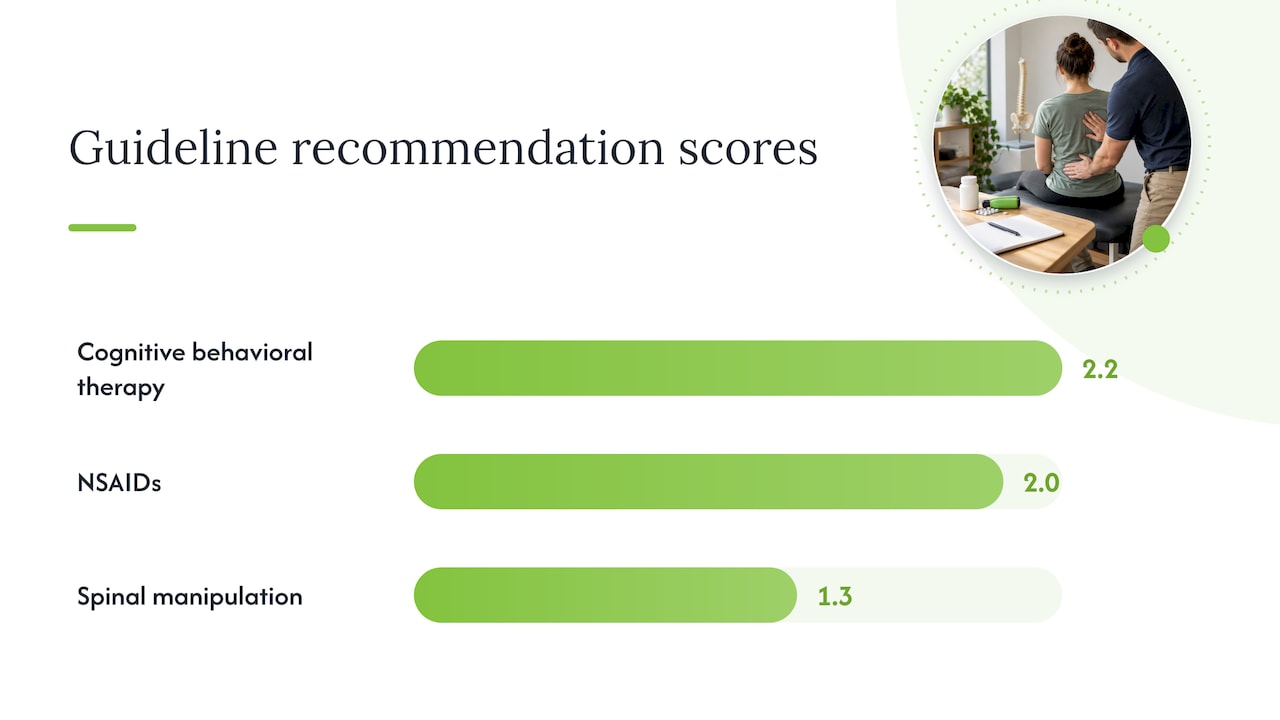
Guidelines. A 2025 systematic review of 12 treatment guidelines in e-Neurospine gave spinal manipulation a moderate recommendation score of 1.3, while cognitive behavioral therapy (2.2) and NSAIDs (2.0) scored highest among noninvasive options. For low back pain more broadly, the American College of Physicians’ 2017 guideline recommends spinal manipulation as an initial nonpharmacologic option for chronic low back pain.
Caution from the literature. The American Family Physician review of manipulative therapies notes that proven benefits are limited and that more high-quality studies are needed before firm recommendations can be made for many conditions. That is a fair reading, and it is why we treat manipulation as one tool within a plan, not a standalone promise.
For what this looks like in practice, our chiropractic case studies describe real treatment courses, and our overview of chiropractic care for lower back pain explains where it tends to help most.
Is it safe? Risks and who should avoid manipulation
For most people with a properly assessed lumbar herniation, serious harm from manipulation is rare. The NCCIH reports that mild to moderate side effects, mostly increased pain, stiffness, or headache, are common after spinal manipulation and usually resolve within 24 hours. Serious spinal or neurologic problems are very rare, and there are no accurate estimates of how often they occur. An earlier NCCIH fact sheet states that in people whose pain comes from a herniated disc, low back manipulation appears to have a very low chance of worsening the herniation. A 2004 systematic review put the risk of clinical worsening or cauda equina syndrome at less than 1 in 3.7 million, though other published estimates range much more widely.
Risk is not the same for everyone. Several sources point to specific situations where manipulation should not be used:
- Neurologic findings. A 9-member expert panel rated every scenario involving major neurologic findings as inappropriate for spinal mobilization and manipulation in chronic low back pain, along with some scenarios involving central herniation, stenosis, or free fragments on imaging.
- Specific risk factors. A 2015 study identified five factors linked to worsening after manipulation: age over 50, repeated back pain episodes alternating with sciatica, back pain and sciatica lasting over five years, MRI-documented severe herniation, and symptoms on both sides. The authors advised against manipulation in patients with one or more of these.
- Bone and general health conditions. Mayo Clinic advises against adjustments with severe osteoporosis, numbness, tingling, or loss of strength in an arm or leg, cancer in the spine, increased stroke risk, or a malformed bone in the upper neck. MedlinePlus lists fractures, severe arthritis, bone or joint infections, and severely pinched nerves with numbness, tingling, or weakness.
The NCCIH also stresses that pre-existing health problems can raise risk, so you should share your full history and medication list with whoever treats you. If you have osteoporosis or osteopenia, ask your physician to clear you before any spinal manipulation.
Why some doctors discourage it
You may have heard that physicians steer patients away from chiropractors for disc problems. Part of this is rooted in real clinical caution. A 2022 article by a chiropractor and molecular scientist in PMC notes that litigation has pushed recent recommendations toward avoiding manipulation in acute disc injury and reserving it for after a period of conservative care. The same author argues that no accepted mechanism explains how manipulation would treat a herniated disc directly, so risk and reward should be weighed case by case.
Part of it is also perception. A 2018 belief study found that spine surgeons were somewhat more pessimistic about disc risk from manipulation than family physicians or chiropractors, despite a lack of scientific evidence to inform those beliefs. The practical takeaway is not that chiropractic is off limits. It is that timing, screening, and technique selection matter.
Neck pain and cervical herniations
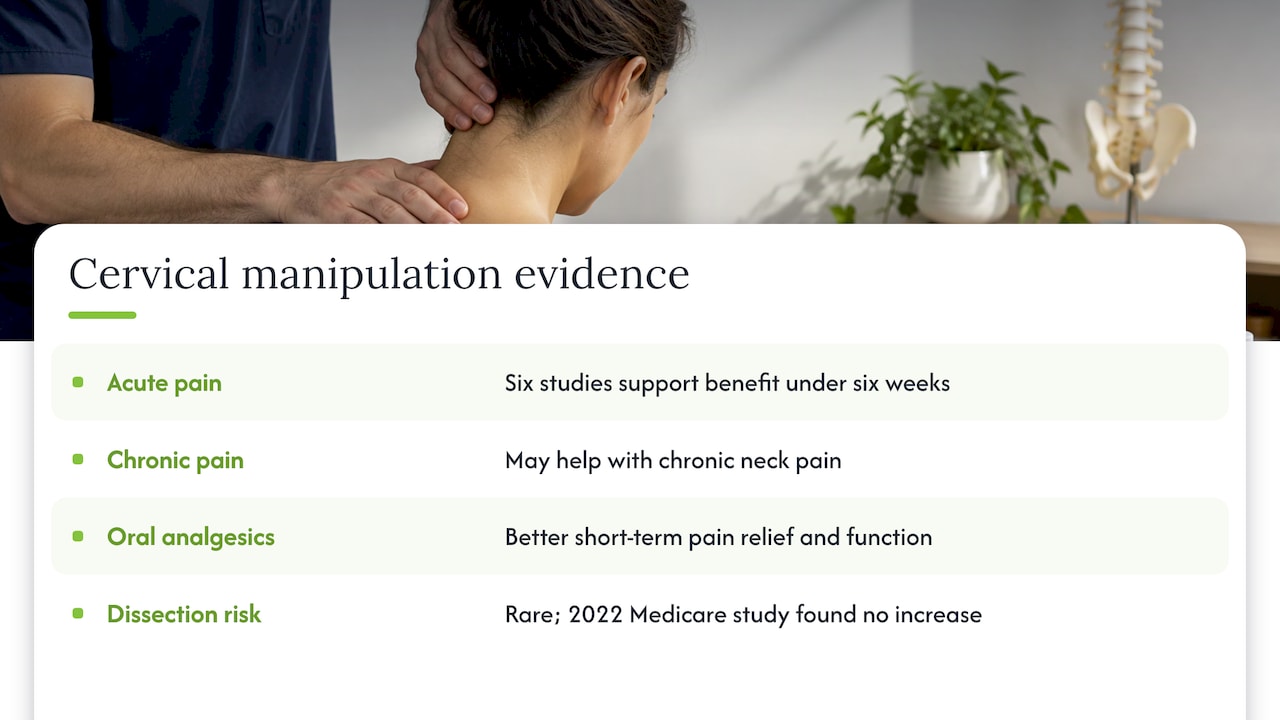
A herniated disc in the neck, which can cause pain, tingling, or weakness into the shoulder and arm, deserves its own caution. The NCCIH says spinal manipulation can help acute neck pain and manipulation or mobilization may help chronic neck pain. A 2021 combined analysis of six studies (446 participants) supported benefit for acute neck pain under six weeks, with the caveat that the evidence was small and varied. A Cochrane review summarized by AFP found cervical manipulation or mobilization appeared to give better short-term pain relief and function than oral analgesics.
The tradeoff is that a type of neck manipulation has been linked to rare cervical artery dissections that can lead to stroke. A 2022 Medicare claims analysis of beneficiaries 65 and older found no greater dissection risk after cervical manipulation than in control groups. Still, Mayo Clinic notes that neck adjustments are less common than low back work. For a neck disc with arm symptoms, gentler mobilization, traction, and targeted rehabilitation are often reasonable first steps. Our pages on the herniated cervical disc and cervical radiculopathy describe how we evaluate these cases.
When to get urgent care instead
Some symptoms mean you should go to an emergency room and not book an adjustment. Cauda equina syndrome is a rare but urgent condition in which the nerves at the base of the spinal canal are compressed. According to Banner Health, go to the ER right away if you have:
- Loss of bladder or bowel control
- Numbness in the groin or saddle area (inner thighs, buttocks, genitals)
- Sudden, severe back pain with leg symptoms
Also get evaluated promptly, by a physician rather than for a routine adjustment, if you notice leg or arm weakness that is getting worse, a foot that drags or slaps, or numbness that is spreading. These suggest significant nerve compression, and the options may include imaging, injections, or a surgical consultation. Our guide to warning signs of spine problems lists other symptoms worth taking seriously.
How many visits, and what to expect
There is no honest universal number. Research gives a useful frame: ISASS cites a survey of 814 neurosurgeons in which 46 percent recommended at least 4 to 8 weeks of nonsurgical management before surgery for lumbar disc herniation with radiculopathy, and Washington State’s health authority requires at least six weeks unless progressive motor weakness is present. Most reasonable plans therefore set a trial window of several weeks, with a clear check-in on whether pain, function, and nerve symptoms are improving.
A sensible course looks like this:
- Assessment first. History, neurologic exam, and imaging when indicated.
- A short trial of care. Often a few weeks, with progress measured by how far you can walk, sit, and sleep, not only by pain scores.
- Reassessment. If leg pain, numbness, or weakness is not improving, the plan changes.
- Active rehabilitation. Exercise and movement retraining help keep gains, and many disc patients do best when manual care is paired with physical therapy. Our comparison of physical therapy and chiropractic explains how the two differ.
Soreness for a day after a session is common. Pain that is clearly worse, or new numbness or weakness, is a reason to stop and call. For sciatica specifically, some people also explore complementary options such as acupuncture for sciatica alongside medical care, which is worth discussing with your clinician.
Our perspective
Many patients come to us after trying several things that each helped a little and none for long. A herniated disc is rarely solved by one technique, and we are cautious about anyone who says otherwise.
We view chiropractic care as a useful conservative option when the exam supports it: a mild to moderate lumbar herniation, no progressive neurologic deficit, and no red flags. In those cases, manual care combined with rehabilitation gives many patients a real chance to improve without an operation, and the research on surgery rates is consistent with that experience.
What sets our approach apart is that conservative care is one step on a ladder, not the whole staircase. Our physicians are Harvard fellowship-trained and board-certified, and we can move from manipulation and physical therapy to image-guided injections, regenerative options such as PRP, or a surgical referral when the exam says it is time. Choosing the right rung, and changing it when the evidence in front of us changes, is the point.
We set expectations plainly. Outcomes vary, timelines are measured in weeks, and some discs need more than hands-on care.
Felix
When conservative care is not enough
If several weeks of well-delivered care have not moved your symptoms, there are steps between adjustments and surgery. Depending on your exam and imaging, these may include epidural steroid injections, facet joint injections, or regenerative treatments. Our regenerative medicine program, including PRP therapy and stem cell therapy for spinal discs, is designed for patients who want to avoid surgery when it is appropriate to try.
If you are in North Dallas and unsure where your disc problem fits, we can examine you, review your imaging, and explain which options make sense. You can start with our back pain therapy page or reach us through nortexspineandjoint.com.
FAQ
Should I go to a chiropractor for a herniated disc?
It can be a reasonable first step if your symptoms are mild to moderate and you have no major weakness, numbness, or bladder or bowel changes. Choose a clinician who performs a full neurologic exam before treating. If you have progressive weakness or any red-flag symptoms, see a physician first.
How many chiropractic visits does it take to fix a pinched nerve?
There is no fixed number, and “fix” overstates what care can promise. Plans commonly use a trial of several weeks followed by a reassessment of pain, function, and nerve symptoms. If you are not improving by then, the plan should change.
Why do some doctors discourage chiropractors for disc problems?
Concerns center on cases with major neurologic findings, certain imaging patterns, and acute disc injury, where expert panels rate manipulation as inappropriate. Some of the pessimism also reflects belief rather than strong data. Proper screening addresses most of these concerns.
Can a chiropractor help with neck pain from a herniated disc?
Sometimes. Manipulation or mobilization may help acute and chronic neck pain, but neck techniques carry rare stroke-related risks, so gentler methods and a careful health history matter. Severe pinched-nerve symptoms in the arm should be evaluated by a physician first.
Sources
- ISASS Policy Guideline: Surgical Treatment of Lumbar Disc Herniation
- Mayo Clinic: Bulging disk vs. herniated disk
- Mayo Clinic: Herniated disk diagnosis and treatment
- MSD Manual: Lumbar Disc Herniation
- BMJ Open: Chiropractic manipulation and discectomy
- e-Neurospine: Systematic review of treatment guidelines
- American College of Physicians 2017 low back pain guideline
- AFP: Manipulative Therapies: What Works
- NCCIH: Spinal Manipulation
- NCCIH: Spinal Manipulation for Low-Back Pain
- Oliphant: Safety of spinal manipulation in lumbar disc herniation
- Expert panel: Clinical scenarios for spinal mobilization and manipulation
- Huang et al.: Lumbar disc herniation exacerbation after manipulation
- Mayo Clinic: Chiropractic adjustment
- MedlinePlus: Chiropractic care for back pain
- Erwin: Should you adjust that herniated disc?
- Belief elicitation study on manipulation and disc herniation risk
- Medicare claims analysis of cervical manipulation and artery dissection
- Banner Health: Cauda Equina Syndrome